



Instant online access
2.000+ organizations
Secure data storage
Build teams that connect, communicate, and collaborate. DISC Boulevard helps organizations around the world unlock the full potential of their employees, leaders, and teams, enabling them to achieve measurable improvements in performance.
Gain insight into behavioral styles, communication preferences, and how someone comes across to others. Learn to understand others better.
→ Read more
Find out what drives people with our motivator profiles. Learn what motivates someone and discover the driving force behind their behavior.
→ Read more
Gain insight into team members’ behavior and improve communication and collaboration. Build stronger and more effective teams.
→ Read more
Gain insight into team members’ motivators and improve communication and collaboration. Build stronger and more effective teams.
→ Read more
The combination assessment brings DISC and motivators together in one profile. Get a complete picture of both how someone behaves and why.
→ Read more
Using the DISC Boulevard online platform, you can easily manage assessments for multiple participants at the same time.
→ Take a look at our method
Obtain credits for assessments
Develop your participants
Joined organizations
Year experience in L&D
More than 250 thousand profiles
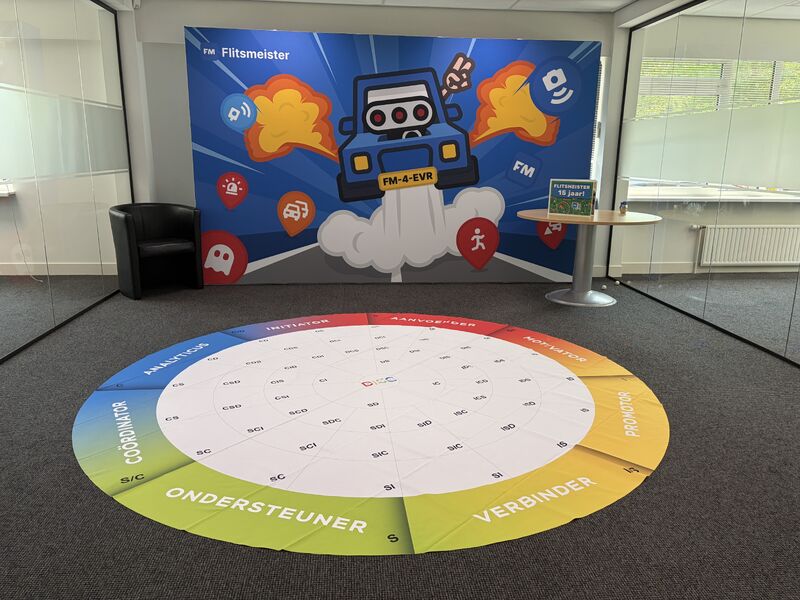
When you start working with new teams, it's time to get to know each other again. Not just on the surface, but a layer deeper. At Flitsmeister, we use the DISC model for this, among other things. As I write this, I can already hear the critical remark: "You're being put in a box." Or: "You're red, so that's why you act like that." But that's not what this is about for me. With this post, I mainly want to show how we at Flitsmeister continuously work on improvement. Of our product, of course, but also on personal development, communication, and collaboration. That's why I took the training at DISC Boulevard in April and May, so I can work with DISC myself, both in personal conversations and with teams. Last Friday, I got to guide a team myself for the first time and put them on the well-known mat. And I really enjoyed doing that! No conversations about boxes came up. Quite the opposite: open, honest, and valuable conversations about how we collaborate, communicate, and can understand each other better. Followed by concrete actions.
⭐⭐⭐⭐⭐![]()

Flitsmeister
juni 2026DISC is a practical model that provides insight into our visible behaviour. It reflects how a person comes across in communication with his or her environment. It measures how the person deals with problems, challenges, rules and procedures, but also how he or she influences others and reacts to changes and tempos.
The analysis shows to what extent the DISC styles are present. This insight into personal behavioural styles is valuable when linked to the effectiveness of certain behaviours in different situations.
The DISC behavioural analysis consists of word chains that the respondent places in order: from most recognisable to least recognisable. Based on the answers, a personal DISC profile is compiled. We look at conscious behaviour and subconscious behaviour of the respondent. As a certified professional, you receive the respondent’s report in your personal account. With your respondent’s DISC report and your expertise as an HR professional, trainer, coach or recruiter, you prove your client your added value. With your practical experience, you use the DISC analysis as a tool for implementing a solution to the client’s problem.
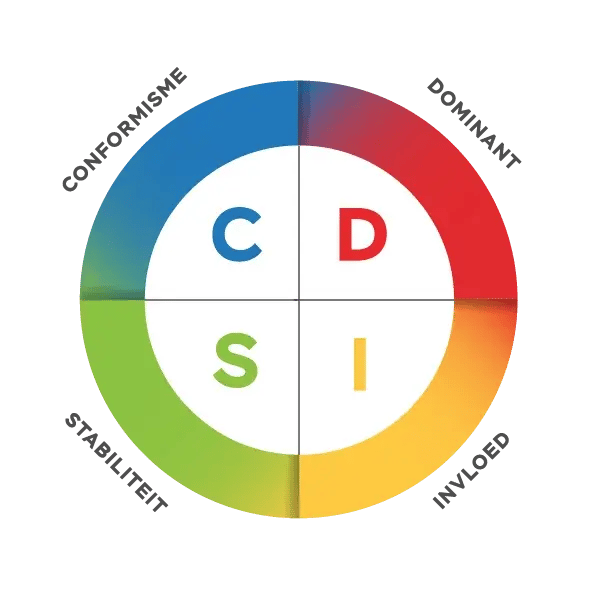
The analysis of behavioural styles is presented in the following categories:
These are indicated in a chart by the four DISC colours: red, yellow, green and blue.
Blogs
De rol van drijfveren in teamdynamiek Effectief samenwerken is een van de belangrijkste bouwstenen voor succes als bedrijf. Om dat goed te doen, moet je eerst begrijpen hoe teams werken en waar ruimte zit voor verbetering. Een belangrijk deel daarvan is het herkennen van en goed omgaan met de […]
Eduard Spranger was een Duitse psycholoog, filosoof en pedagoog, geboren op 27 juni 1882 in Berlin-Charlottenburg. Hij werd bekend door zijn onderzoek naar de innerlijke drijfveren die bepalen hoe mensen denken, voelen en handelen. Zijn werk had grote invloed op de psychologie, filosofie en […]
Waar word jij enthousiast van, en op welke momenten draai jij je liever nog een keer om? De keuzes die we maken, worden voor een groot deel bepaald door onze drijfveren. Maar wat zijn drijfveren precies? Drijfveren laten zien wat iemand belangrijk vindt in het leven, wat iemand wil bereiken en […]
What is the DISC model?
DISC is a behavioural model that provides insight into preferred behaviour. It maps out how a person communicates, responds to others and deals with challenges and decisions always in relation to the context. The model is structured around four behavioural styles: dominance, influence, stability and conscientious. DISC says nothing about who a person is or what drives them. It simply reveals how a person behaves, and that is precisely what makes the model valuable for teams and organisations.
How does DISC improve collaboration within teams?
Collaboration rarely breaks down because people are unwilling. It breaks down because what one person takes for granted can actually cause friction for another. DISC maps out the behavioural patterns of an entire team and highlights where the strengths lie, where blind spots may arise and how the team reacts under pressure. These insights form the starting point for better mutual coordination. Not as a one-off exercise, but as a way of looking at things that sharpens collaboration on a daily basis.
What do the DISC behavioural styles mean?
DISC identifies four behavioural styles, each with its own colour. Red stands for dominance. Yellow stands for influence. Green stands for stability. Blue stands for conscientious. Each style has its own strengths, and each style can become extreme under pressure. It is not about labelling people, but about recognising behavioural patterns and adapting effectively to them.
Who is DISC suitable for?
DISC is suitable for anyone who works with people and would benefit from a better understanding of behaviour. In practice, it is used by leaders who want to understand their team better, managers who want to communicate more effectively, coaches who support individual development, and HR professionals working on team development and organisational change. DISC can be applied across a wide range of sectors and organisations.
How quickly do results become apparent?
Get in touch for advice or if you have any questions.
Our team will contact you within a day.